
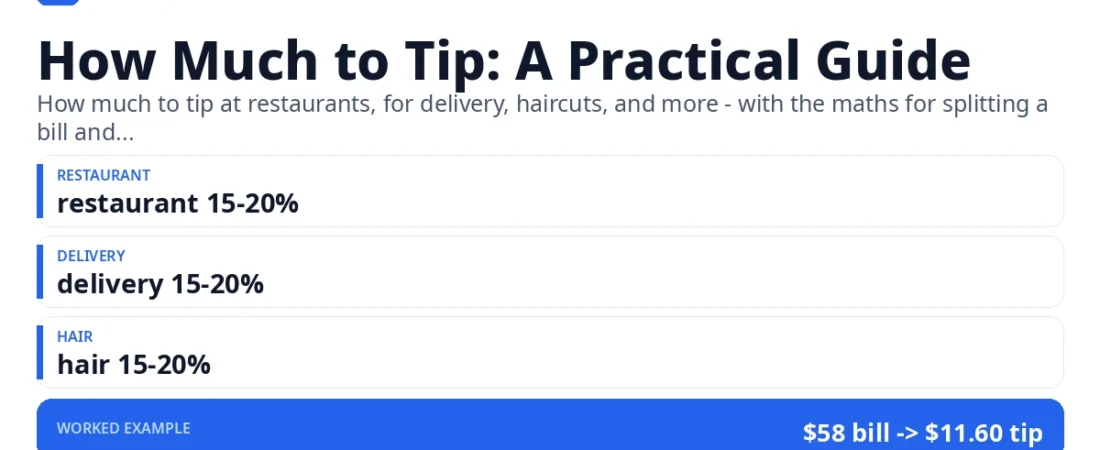
At a sit-down restaurant in the US, 15% to 20% of the pre-tax bill is the usual range, with 20% the common default for good service. Delivery, haircuts, bars, and hotels each have their own range, and tipping is not expected everywhere. This page covers the amounts, the maths, and the cases where you should not tip at all.
The restaurant tip
Take the pre-tax total from the receipt, and multiply by the percentage you want to leave. On a $58.00 bill at 20%: 58.00 × 0.20 = $11.60. The table pays $58.00 + $11.60 = $69.60 before tax, plus whatever tax is on the receipt.
Use the pre-tax figure as the base. That is the usual convention, and it is the number printed on the receipt before tax is added. Tipping on the after-tax total is not wrong — it just comes out a little higher — but if you tip on the pre-tax bill every time, your percentages stay comparable from meal to meal.
If you used a coupon or gift card, tip on the full pre-discount total. The server did the same work whether or not you had a discount.
Before tax or after tax?
The difference is small on one meal. On that $58.00 bill with 8% tax: tax is 58.00 × 0.08 = $4.64. A 20% tip on the pre-tax bill is $11.60. A 20% tip on the after-tax total is (58.00 + 4.64) × 0.20 = 62.64 × 0.20 = $12.53. The gap is $0.93. Over a year of eating out, that gap adds up, which is why picking one base and staying with it matters more than which one you pick.
Splitting the bill
Add the tip first, then divide the total. A $148.00 bill, 18% tip, split between 4 people: tip is 148.00 × 0.18 = $26.64. Total is 148.00 + 26.64 = $174.64. Each share is 174.64 ÷ 4 = $43.66.
For an uneven split — one person had the steak, another had a salad — work out each person’s food and drink first, then add each person’s share of tax and tip. Splitting the total evenly when orders were very different is the fastest way to start an argument.
If the shares come out uneven, rounding each share up to the next whole dollar leaves a few cents extra, which covers the rounding gap without a coin hunt.
How much to tip, by situation
These are US customs, not rules. Good service earns more, poor service less. In many other countries the norms are different (see below).
| Situation | Usual range |
|---|---|
| Sit-down restaurant | 15–20% of the pre-tax bill |
| Food delivery | 15–20% of the bill |
| Hairdresser or barber | 15–20% of the service price |
| Bartender | $1–$2 per drink, or 15–20% on a tab |
| Taxi or rideshare | 15–20% of the fare |
| Hotel housekeeping | $2–$5 per night, left daily |
| Hotel porter | $1–$2 per bag |
| Buffet | 10–15%, since someone still clears and refills |
A few details worth knowing. For delivery, tip more in bad weather or for a large, heavy, or complicated order. At a salon, if someone else washed your hair, a small separate tip for them is customary. For housekeeping, leave the tip daily rather than at checkout, since different people may clean the room on different days. And for a haircut that took far longer than usual, the top of the range is the fair choice.
When not to tip
Check the receipt before adding anything. Some bills already include a service charge or gratuity, especially for large groups — tipping on top of that means paying twice. Look for “service charge,” “gratuity,” or “service included.”
At counter-service and takeout spots, tipping is not expected. A tip jar may be sitting there, and leaving something is a nice gesture, but it is not required. The same goes for a checkout screen that suggests a tip at a shop where nobody served you — those prompts are the shop’s choice, not an obligation. Tips are voluntary: you can pick a custom amount, a suggested amount, or nothing, and cash tips are always acceptable.
Do not tip where tipping is not customary for the role — for example, you would not tip a doctor, a teacher, or a plumber for doing their job at its quoted price. A thank-you note or a positive review is the right gesture there.
Tipping in other countries
Tipping is mostly a US habit. In much of Europe, a service charge is often already included in the bill, and a small extra — rounding up, or a few percent — is enough where service is not included. In Japan, tipping is not customary and can even be awkward, since good service is treated as part of the job. In some countries, tipping certain workers is not expected at all because staff are paid a full wage.
The safe move when travelling: check local norms before you go, and look at the bill for an included service charge before adding anything. “When in doubt, ask” is genuinely good advice here — hotel staff will usually tell you what is normal.
Working out a tip in your head
Use 10% as the building block. 10% is the bill with the decimal point moved one place left. Double it for 20%, halve it for 5%, and combine the pieces for anything else.
On a $73.40 bill: 10% is $7.34. Double it for 20%: $14.68. Half of 10% is 5%: $3.67. So 15% is 10% + 5% = 7.34 + 3.67 = $11.01.
For 18%, take 10% + 5% + 3%: on a $64.50 bill, that is 6.45 + 3.23 + 1.94 = $11.62 (3% is three lots of 1%, and 1% of 64.50 is $0.65, so 3% is $1.94). The exact 18% of $64.50 is $11.61 — the one-cent gap is rounding in the building blocks, and it does not matter at the table.
Where it usually goes wrong
Tipping on the after-tax total without realising it. Card machines and apps sometimes compute the suggested tip on the total including tax. The tip is a little higher than the percentage suggests. Check which base the suggestion uses.
Tipping twice. A service charge on the receipt plus a tip on top. Read the receipt first.
Splitting before adding the tip. Dividing the food total, then having everyone guess their tip share, produces rounding errors and shortfalls. Add the tip to the total first, then divide.
Forgetting the discount. Tipping on the discounted total after a coupon short-changes the server. Tip on the pre-discount amount.
Three to try yourself
Work these out before reading the answers below.
- A $92.00 bill, 20% tip — what is the tip, and what is the total before tax?
- A $36.50 delivery order, 15% tip — what is the tip?
- A $96.00 bill, 18% tip, split between 3 people — what does each person pay?
Answers: 1. Tip $18.40 (92.00 × 0.20); total $110.40 before tax. 2. $5.48 (36.50 × 0.15 = 5.475, rounded to $5.48). 3. Tip $17.28 (96.00 × 0.18); total $113.28; each person pays $37.76 (113.28 ÷ 3).
Questions people ask
How much should I tip at a restaurant?
In the US, 15–20% of the pre-tax bill for sit-down service, with 20% the common default for good service. Tip on the pre-tax total, and on the full amount before any coupon or gift card.
How much should I tip a hairdresser?
15–20% of the service price is the usual range. If someone else washed your hair, a small separate tip for them is customary. For a long or difficult appointment, the top of the range is fair.
How much should I tip a delivery driver?
15–20% of the bill is the usual range for food delivery. Tip more in bad weather or for a large or awkward order. Remember that a service fee on an app does not necessarily go to the driver, so the tip is the part that reaches them.
Should I tip if the service was bad?
You can tip less than usual for poor service — 10% signals that something was wrong without stiffing the server entirely. If something was genuinely wrong with the food or the bill, raising it with the manager is more useful than leaving nothing in silence.
Do I have to tip on a takeout order?
No. Tipping is not expected on takeout or counter-service orders. Leaving a small amount is a nice gesture, especially for a complicated order, but it is not required.
If you would rather skip the mental maths, try it in the Tip Calculator.
By Sofia Andersen
CalcKits calculators show the formula with every result.