
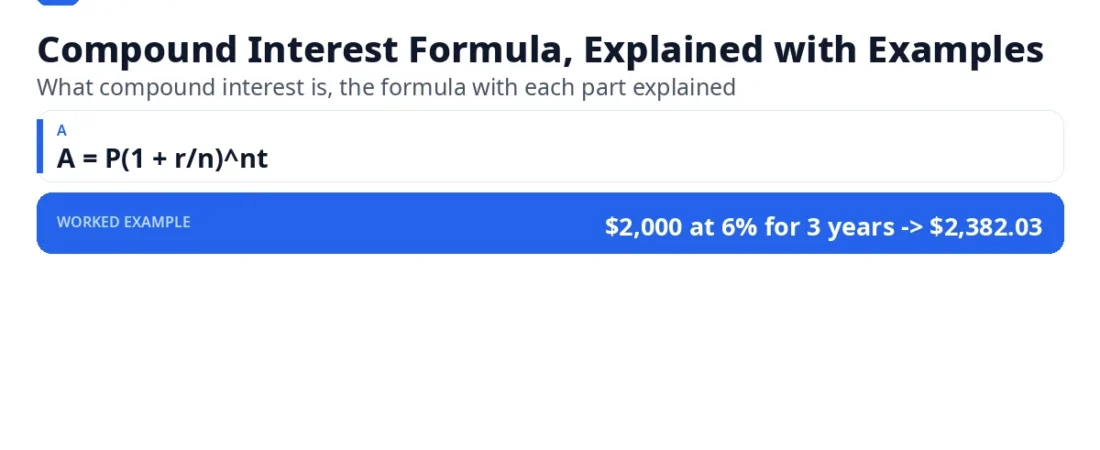
Compound interest is interest earned on your interest. Each period, the interest joins the balance, and the next period’s interest is charged on the new, larger balance. Put $2,000 in an account at 6% compounded once a year: after 3 years it is $2,382.03, not the $2,360.00 simple interest would give. The $22.03 gap is compounding.
General information only — this page explains the maths. It is not financial, investment, tax, or legal advice.
Simple interest vs compound interest
Simple interest pays only on the original amount. Compound interest pays on the original amount plus everything earned so far.
On $2,000 at 6% for 3 years:
- Simple: $2,000 × (1 + 0.06 × 3) = $2,000 × 1.18 = $2,360.00. Interest: $360.00.
- Compound (yearly): $2,000 × (1 + 0.06)³ = $2,000 × 1.191016 = $2,382.03. Interest: $382.03.
Year by year, the compound version looks like this: $2,000 → $2,120.00 → $2,247.20 → $2,382.03. The second year’s interest is 6% of $2,120, not of $2,000, which is why the yearly interest grows: $120.00, then $127.20, then $134.83.
The formula, part by part
A = P × (1 + r ÷ n)^(n × t)
- A — the final amount, what you end up with.
- P — the starting amount (principal).
- r — the yearly rate as a decimal, so 6% is 0.06.
- n — how often interest compounds each year: 1 for yearly, 4 for quarterly, 12 for monthly, 365 for daily.
- t — the number of years.
- n × t — the total number of compounding periods.
The piece inside the brackets, (1 + r ÷ n), is the growth multiplier for one period. Raising it to the power of n × t applies that growth once per period across the whole time. To get the interest alone, subtract the starting amount at the end: interest = A − P.
For interest only, some sources write it as Interest = P × (1 + r ÷ n)^(n × t) − P. It is the same formula with the principal subtracted.
A worked example without deposits
$5,000 at 4% for 5 years, at four compounding frequencies:
| Frequency | Calculation | Final amount |
|---|---|---|
| Yearly (n = 1) | $5,000 × (1.04)^5 | $6,083.26 |
| Quarterly (n = 4) | $5,000 × (1.01)^20 | $6,100.95 |
| Monthly (n = 12) | $5,000 × (1.003333)^60 | $6,104.98 |
| Daily (n = 365) | $5,000 × (1.0001096)^1825 | $6,106.95 |
Moving from yearly to monthly compounding adds $21.72. Moving from monthly to daily adds $1.97. Frequency helps, but the gains shrink fast — rate and time matter far more than whether interest compounds monthly or daily.
With regular deposits
When you add money each month, two things grow: the starting balance and the deposits. The formula gains a second part for the deposits:
A = P × (1 + r ÷ n)^(n × t) + PMT × [((1 + r ÷ n)^(n × t) − 1) ÷ (r ÷ n)]
PMT is the monthly deposit. The first part grows your starting balance; the second part grows your deposits.
Example: start with $3,000, add $150 a month, 6% compounded monthly, 10 years. The monthly rate is 0.06 ÷ 12 = 0.005, and there are 12 × 10 = 120 periods. The growth factor (1.005)^120 is 1.819397.
- Starting balance grows to $3,000 × 1.819397 = $5,458.19.
- Deposits grow to $150 × ((1.819397 − 1) ÷ 0.005) = $150 × 163.879 = $24,581.90.
- Final amount: $5,458.19 + $24,581.90 = $30,040.09.
You put in $3,000 + ($150 × 120) = $21,000, so the interest earned is $30,040.09 − $21,000 = $9,040.09. Split apart, the monthly deposits grew to $24,581.90 from $18,000 paid in — a $6,581.90 gain on the deposits — and the starting $3,000 grew by $2,458.19.
The Rule of 72
To estimate how long money takes to double, divide 72 by the yearly rate in percent. At 8%, 72 ÷ 8 = 9 years. The exact answer is 9.01 years, so the shortcut is very close. At 6%, 72 ÷ 6 = 12 years; the exact answer is 11.90 years.
The rule works best for rates between about 4% and 12%. Outside that band it drifts. It also runs backwards: to double your money in 10 years, you need about 72 ÷ 10 = 7.2% a year.
Why the curve bends late
Growth looks slow in the first few years, then steepens. That is normal: the balance is largest late in the period, so the interest earned each year is largest then too. Starting earlier usually beats saving more later, because compounding has more time to work. The same maths works in reverse on debt — on a loan, unpaid interest can be added to the balance, so you end up paying interest on interest.
Compound interest in Excel
In a spreadsheet, the same result comes from the future-value function:
=FV(rate, nper, pmt, pv)
For $8,000 at 5% compounded monthly for 8 years, with no deposits: =FV(5%/12, 8*12, 0, -8000) gives $11,924.68. The negative sign on the starting amount is a spreadsheet convention so the answer comes out positive.
Where it usually goes wrong
Using the yearly rate as the monthly rate. At 6% compounded monthly, the monthly rate is 0.06 ÷ 12 = 0.005, not 0.06. Plugging in 6% a month would grow the balance absurdly fast and the answer would be nonsense.
Forgetting the deposits have their own timing. Deposits made during the period earn interest only from when they go in. A deposit in year 9 earns far less interest than one in year 1. The deposits formula handles this; a rough “deposits × rate × years” does not.
Treating an illustration as a forecast. A fixed-rate example shows the mechanics. Real returns move up and down, and fees, taxes, and inflation all cut into the result. The formula tells you how compounding works, not what your account will earn.
Comparing rates without matching frequency. A 4% rate compounded monthly beats a 4% rate compounded yearly by a little. Comparing two rates fairly means comparing them at the same frequency, or comparing their annual percentage yields.
Three to try yourself
Work these out before reading the answers below.
- $1,000 at 5% compounded yearly for 2 years — what is the final amount?
- $4,000 at 6% compounded yearly for 4 years — what is the final amount?
- At 6%, about how long does money take to double (Rule of 72)?
Answers: 1. $1,102.50 ($1,000 × 1.05 = $1,050 after year 1; $1,050 × 1.05 = $1,102.50 after year 2). 2. $5,049.91 ($4,000 × 1.06^4 = $4,000 × 1.262477). 3. About 12 years (72 ÷ 6); the exact figure is 11.90 years.
Questions people ask
How does compound interest work?
You earn interest on your savings and on the interest you have already earned. Each period, the interest is added to your balance, and the next period’s interest is calculated on the new, larger balance. Over time the balance grows faster than it would with simple interest. The US Consumer Financial Protection Bureau explains it the same way, with a $1,000 at 5% example that reaches $1,102.50 after two years.
What is the compound interest formula with monthly contributions?
A = P × (1 + r ÷ n)^(n × t) + PMT × [((1 + r ÷ n)^(n × t) − 1) ÷ (r ÷ n)], where PMT is the monthly deposit. The first part grows the starting balance; the second part grows the deposits.
Does compounding frequency matter much?
Somewhat, but less than people expect. On $5,000 at 4% for 5 years, yearly compounding gives $6,083.26 and daily gives $6,106.95 — a $23.69 gap. Rate and time move the answer far more.
How do I calculate compound interest in Excel?
Use =FV(rate, nper, pmt, pv) with the rate divided by 12 for monthly compounding and the number of periods in months. For $8,000 at 5% monthly for 8 years with no deposits: =FV(5%/12, 8*12, 0, -8000) = $11,924.68.
Does compound interest apply to loans?
Yes, and on loans it works against you. On a loan, unpaid interest can be added to the balance, so you end up paying interest on interest. That is one reason paying a loan down early saves so much.
If you would rather skip the arithmetic, try it in the Compound Interest Calculator. The Consumer Financial Protection Bureau’s explainer is at consumerfinance.gov.
By Lucas Meyer
CalcKits calculators show the formula with every result.