
Take any number, divide it by 100, and you have one percent of it. Everything else below builds on that single move.
This page shows how to calculate percentage in every direction: of a number, as a share, as a change, and as a discount. To find a percentage of a number, multiply by the percent and divide by 100. To work out what percent one number is of another, divide the first by the second and multiply by 100.
What “percent” means
Percent means per hundred. 50% is 50 out of every 100. 75% is 75 out of every 100. That is all the word ever means, and it is why the same three formulas keep showing up: you are always comparing something to 100, or to a base number.
A quick example. A class has 40 students and 30 of them pass. 30 ÷ 40 = 0.75, and 0.75 × 100 = 75. So 75% of the class passed. The rest is that same idea, turned in three directions.
Percent and decimal are two ways of writing the same number. Divide the percent by 100 to get the decimal (25% = 25 ÷ 100 = 0.25), and multiply a decimal by 100 to get the percent (0.85 × 100 = 85%). A fraction works the same way: 3/4 = 0.75 = 75%. Every example below uses this conversion, so it is worth knowing before the formulas.
How to calculate a percentage of a number
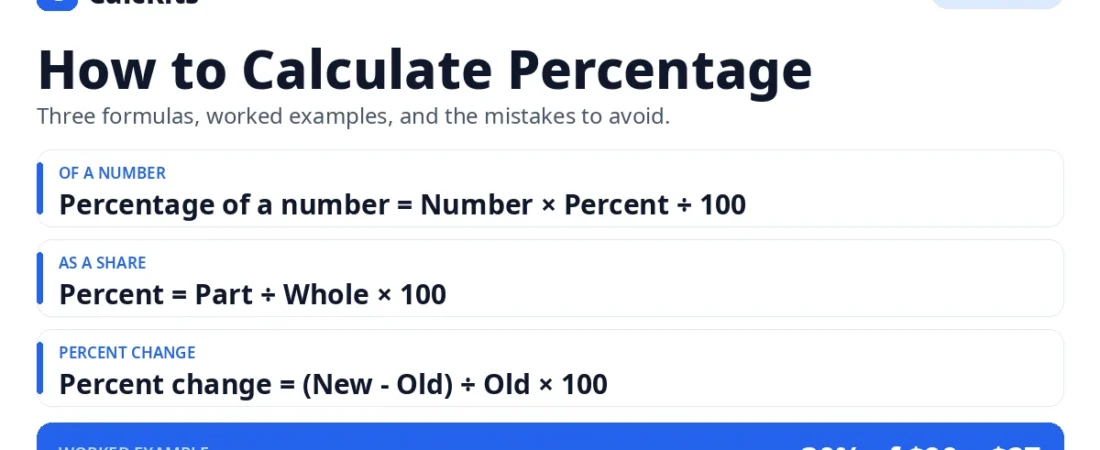
To find the percentage of a number, use this:
Percentage of a number = Number × Percent ÷ 100
A 15% tip on a $240 bill: 240 × 15 ÷ 100 = 3,600 ÷ 100 = 36. The tip is $36.
A shop marks 30% off a $90 jacket: 90 × 30 ÷ 100 = 2,700 ÷ 100 = 27. You save $27.
A 12% tax on a $1,250 laptop: 1,250 × 12 ÷ 100 = 15,000 ÷ 100 = 150. The tax is $150.
Notice the pattern. You never need a special trick. Multiply, divide by 100, done.
Working backwards: what percent is one number of another?
Sometimes you have the part and the whole. Here is how to find the percentage of a number in that case — the formula flips:
Percent = Part ÷ Whole × 100
That $36 tip on the $240 bill: 36 ÷ 240 × 100 = 0.15 × 100 = 15%. So the tip was 15%.
The $27 saving on the $90 jacket: 27 ÷ 90 × 100 = 0.3 × 100 = 30%. So the discount was 30%.
How to calculate the percentage of a total
The same formula answers “what share of the total is this?” Add up the total first, then divide the part by it.
Take monthly spending of $2,400, with rent at $900 of that. 900 ÷ 2,400 × 100 = 0.375 × 100 = 37.5%. Rent is 37.5% of your spending. People get this one wrong by dividing by the wrong total, so check that your total really includes everything before you divide.
Percent change: how much did it move?
The percentage change formula compares a new value with the old one:
Percent change = (New − Old) ÷ Old × 100
A plus sign means the value grew; a minus sign means it shrank.
Rent goes from $1,200 to $1,320. (1,320 − 1,200) ÷ 1,200 × 100 = 120 ÷ 1,200 × 100 = 10. Rent rose 10%.
A price falls from $45 to $36. (36 − 45) ÷ 45 × 100 = −9 ÷ 45 × 100 = −20. The price dropped 20%.
The old value is always the base. Divide by the new value by mistake and the answer is wrong even though the arithmetic looks fine. Use the old value’s size as the denominator, so the sign of the answer comes from the change itself. The same formula covers both directions: a rise gives a positive answer, a drop gives a negative one.
Percent off: the shop version
Here is how to calculate percent off: find what you save, then subtract it from the price.
What you save = Original price × Percent off ÷ 100
What you pay = Original price − What you save
A $120 coat at 30% off: 120 × 30 ÷ 100 = 3,600 ÷ 100 = 36. You save $36 and pay 120 − 36 = $84.
A $45 shirt at 20% off: 45 × 20 ÷ 100 = 900 ÷ 100 = 9. You save $9 and pay 45 − 9 = $36.
Where it usually goes wrong
Four mistakes show up again and again.
The base moved. A $100 item drops 10% to $90, then rises 10%. It does not come back to $100, because the second 10% is taken from $90, not $100. 90 × 10 ÷ 100 = 9, so the price lands at $99. Whenever a percent goes up and then down (or the reverse), check which number each percent is taken from.
Percentage points are not percent. An interest rate moving from 3% to 4% rose by 1 percentage point. As a relative change it rose (4 − 3) ÷ 3 × 100 = 33.33%. Both statements are true. They answer different questions, and mixing them up makes a small move sound huge or a huge move sound small. Round to the precision the question needs.
Two discounts do not add. A 20% discount followed by another 20% is not 40% off. $100 becomes $80 after the first discount, then $80 × 0.8 = $64 after the second. You saved $36, which is 36%, not 40%. Shops stack discounts this way, so work them one at a time.
You cannot take a percent change from zero. A shop with 0 sales last month and 5 this month has no percent change, because the formula would divide by zero. “Up 5 sales” is the honest way to say it.
Three to try yourself
Work these out before reading the answers below.
- What is 25% of 320?
- 18 is what percent of 72?
- A $65 bill with a 15% tip — what is the tip?
Answers: 1. 80 (320 × 25 ÷ 100 = 8,000 ÷ 100). 2. 25% (18 ÷ 72 × 100 = 0.25 × 100). 3. $9.75 (65 × 15 ÷ 100 = 975 ÷ 100).
Questions people ask
What is the difference between a percent and a percentage point?
A percent is relative. A percentage point is the plain arithmetic gap between two percents. A rate going from 3% to 4% rose 1 percentage point, which is a 33.33% relative rise. Use percentage points when you compare two rates. Use percent when you describe how much something grew or shrank relative to where it started.
How do I work out a percentage in my head?
Use 10% and 1% as building blocks. 10% of 240 is 24. Half of that, 5%, is 12. So 15% is 24 + 12 = 36. 1% of 240 is 2.40, so 2% is 4.80 and 3% is 7.20. Break any percent into tens and ones and the arithmetic stays small.
How do I find the percentage of a total?
Add up the total, divide the part by it, and multiply by 100. A class of 30 students has 18 girls: 18 ÷ 30 × 100 = 60%. The usual error is a wrong total, so make sure the total includes every part before you divide.
If you would rather skip the arithmetic, try it in the Percentage Calculator.
By Lucas Meyer
CalcKits calculators show the formula with every result.