









The Power of Consistency: Why Consistency Beats Talent Every Time
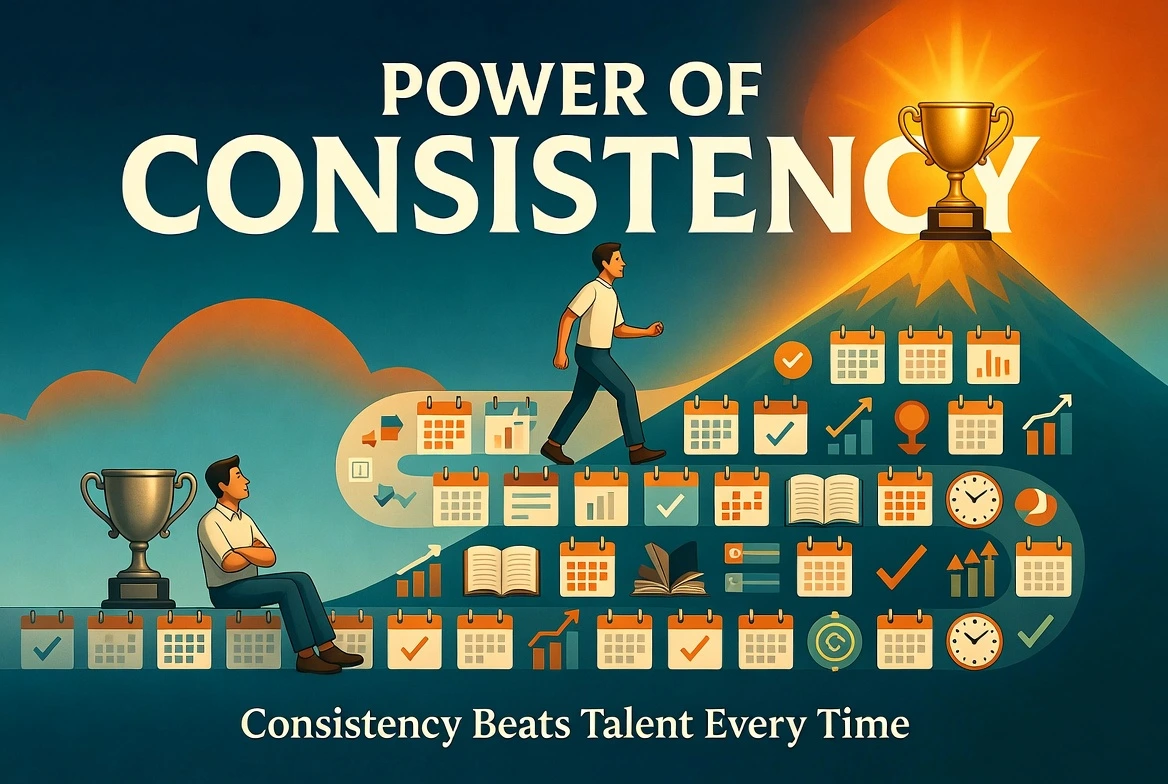
Why Consistency is More Important Than Talent: The Power of Consistency
Have you ever wondered why some people with amazing natural gifts never achieve big things, while others who seem ordinary end up changing the world? The secret often lies in something simple yet powerful: consistency. Many believe talent alone leads to success, but the power of consistency proves time and again that steady effort beats raw talent in the long run.
Imagine two students in school. One is super smart and picks up math easily but only studies when he feels like it. The other works hard every single day, even on tough days. After a year, who do you think gets better grades and feels more confident? The consistent one usually wins. This article explores why consistency matters more than talent. We will look at real examples, simple science, and easy tips anyone can use. By the end, you will see how the power of consistency can help you reach your dreams—no matter where you start.
Consistency is not flashy like talent. It does not show up in big moments. Instead, it works quietly every day. And that is exactly why it wins.
What Talent Really Means (and Why It Is Not Enough)
Talent is a natural ability. Some kids run faster, draw better, or solve puzzles quicker without much practice. It feels like a gift. Parents and teachers often praise talented children, saying things like “You are so gifted!”
But talent has limits. It can make starting easy, yet it does not guarantee growth. Without regular practice, talent stays the same or even fades. Think of a shiny new bicycle. If you never ride it, it collects dust and rusts. Talent works the same way.
Studies show talent alone rarely leads to lasting success. Psychologist Angela Duckworth spent years researching this. In her book Grit, she found that passion and perseverance predict achievement better than IQ or natural talent. At places like West Point military academy and national spelling bees, the grittiest students outperformed the most talented ones.
Talent is like the starting line in a race. Consistency is what keeps you running until the finish.
The Hidden Power of Consistency
The power of consistency comes from doing small things regularly. It is not about working hard once in a while. It is about showing up every day, even when you do not feel like it.
James Clear, author of the bestselling book Atomic Habits, explains this beautifully. He says tiny improvements of just 1% each day can lead to huge results over time. This is called the compound effect. Like interest in a bank account, small consistent actions grow bigger and bigger.
Consistency builds habits. Habits make hard things feel easy. It also creates momentum—like pushing a snowball downhill. At first it is small, but soon it rolls on its own. The power of consistency turns average skills into strong ones and dreams into reality.
Unlike talent, which you are born with, consistency is something anyone can choose. That makes it fair and powerful for everyone.
The Science Behind the Power of Consistency
Science backs up why consistency beats talent. Our brains change when we repeat actions—this is called neuroplasticity. Daily practice strengthens brain connections, making you better at skills over time.
Angela Duckworth’s research on grit shows that consistent effort (perseverance) matters more than talent for long-term goals. In one study, gritty cadets at West Point succeeded where talented but less determined ones dropped out.
Darren Hardy, in his book The Compound Effect, shares real data. He explains how consistent small choices—like reading 10 pages a day—can lead to reading dozens of books a year and massive knowledge growth. Talent might help you read faster at first, but without consistency, you stop.
The formula is simple, according to these experts:
Talent × Effort = Skill
Skill × Effort = Achievement
Notice how effort (consistency) appears twice? That is the power of consistency at work.
Real-Life Success Stories: Consistency in Action
History is full of people who won through the power of consistency.
- Thomas Edison, the inventor of the light bulb, tried over 10,000 times before he succeeded. People called him a failure, but he said, “I have not failed. I’ve just found 10,000 ways that won’t work.” His consistency turned a good idea into one of the greatest inventions ever.
- J.K. Rowling wrote the first Harry Potter book while struggling as a single mom. Twelve publishers rejected it. Many talented writers would have quit, but Rowling kept sending it out consistently. Today, her books have sold over 600 million copies.
- Michael Jordan, widely called the greatest basketball player ever, was cut from his high school varsity team. He practiced for hours every day—before school, after school, and even on weekends. His consistency and work ethic made him a legend.
These stories show one clear truth: the power of consistency turns “no” into “yes” and ordinary starts into extraordinary endings.
Consistency vs Talent: A Simple Side-by-Side Comparison
| Aspect | Talent Without Consistency | Consistency Without High Talent | Winner and Why |
|---|---|---|---|
| Long-term Growth | Skills stay the same or get rusty | Skills improve steadily over time | Consistency – builds real strength |
| Handling Failure | Gives up easily when things get hard | Learns and keeps going | Consistency – turns mistakes into lessons |
| Daily Life | Big starts but often loses motivation | Small daily wins that add up | Consistency – creates habits and momentum |
| Final Results | Early success that fades | Slow start but huge success later | Consistency – compounds into big wins |
| Controllability | You cannot choose your natural talent | Anyone can choose to show up daily | Consistency – fair for everyone |
Practical Ways to Build the Power of Consistency
You do not need to be perfect to start. Here are simple, easy steps anyone (even a 7th grader) can follow:
- Start tiny: Pick one small habit, like practicing math for just 10 minutes a day. Small wins build confidence.
- Use a system, not willpower: Set a fixed time and place for your activity. James Clear calls this “habit stacking”—link it to something you already do, like brushing teeth before reading.
- Track your progress: Use a simple notebook or chart. Seeing checkmarks every day feels great and keeps you going.
- Remove distractions: Keep your phone away during practice time. Make the right choice the easy choice.
- Be kind to yourself on bad days: Everyone misses a day sometimes. Just start again tomorrow. Consistency is about getting back on track, not being perfect.
- Find a why: Remind yourself why this matters to you. A strong reason fuels the power of consistency.
Try these for 30 days. You will be amazed at the change.
Common Myths About Consistency (and the Truth)
Myth 1: “Consistency is boring.”
Truth: It feels boring at first, but the results are exciting!
Myth 2: “I need motivation every day.”
Truth: Motivation comes and goes. Systems and habits keep you moving even without big feelings.
Myth 3: “Only talented people can be consistent.”
Truth: Consistency is a skill anyone can learn, just like riding a bike.
The Many Benefits of Choosing Consistency
When you embrace the power of consistency, wonderful things happen:
- You build real confidence because you prove to yourself you can keep going.
- Skills improve faster than you expect.
- You develop strong character traits like patience and resilience.
- Success feels earned and lasts longer.
- You inspire others around you.
Consistency also reduces stress. Instead of waiting for perfect talent or perfect days, you simply do the next right thing.
Start Today: Your First Step Toward the Power of Consistency
Consistency is more important than talent because it is under your control. Talent might open doors, but consistency walks you through them and keeps them open.
The power of consistency is available to every person reading this. You do not need to be the smartest, fastest, or most gifted. You only need to show up today—and tomorrow, and the day after.
Pick one small goal right now. Write it down. Take one tiny step today. In a year, you will look back and smile at how far the power of consistency has taken you.
Remember: The race is not always won by the fastest or most talented. It is won by the one who keeps running.
Start small. Stay steady. Watch the magic happen.

